


The Curtin Guild’s women’s officer is concerned over comments made by newly-appointed federal Nationals leader Matt Canavan which she says dehumanises women and promotes harmful views on race and multiculturalism in Australia.
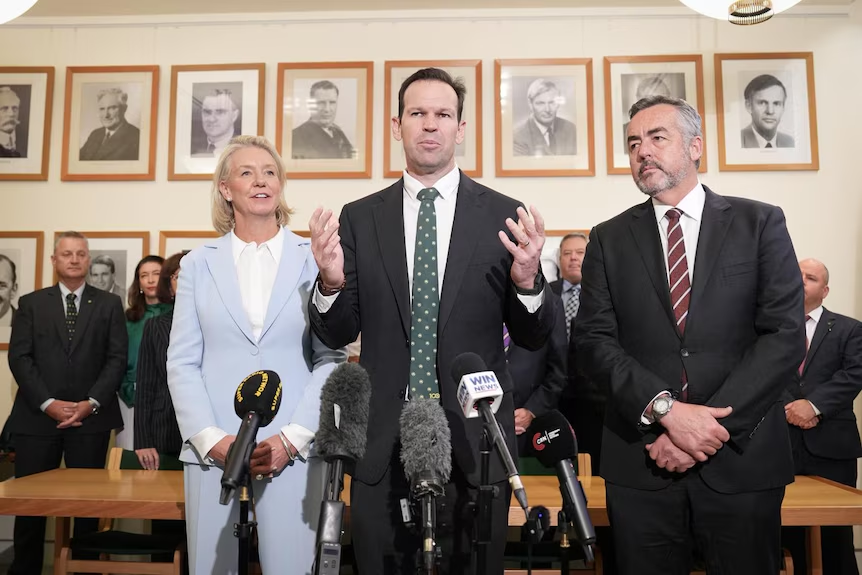
Yesterday, during his first press conference as party leader, Canavan called on the nation to make “more Australian babies”, urging “we need to manifest a hyper Australia”.
Guild women’s officer Sarah Abed says the comments surrounding reproduction are damaging to women, painting them as “birthing machines” and pushing certain agendas on racial identity.
“He doesn’t really view us as people, moreso something to further his ideas on race,” she says.
Ms Abed says bodily autonomy is important for women’s rights and the government shouldn’t be involved in their reproductive decisions.
“I don’t believe the government should have any place in reproductive rights. I believe that every women’s body is her own. Her body her choice. She should be able to make the decisions regarding them.”

Multiculturalism takes a hit
Ms Abed is also concerned Canavan is using racism to make political gains.
She says the use of the term “Australian babies” feels like it deliberately excludes non-white Australians from the strong, nationalist push by the Nationals leader.
“He is definitely talking about white Australians – people from the UK or Europe. I don’t think he is talking about multicultural Australians or Indigenous Australians,” she says.
Curtin University politics Professor Alan Fenna says Canavan’s comments are mainly symbolic of aspirations for tighter policies on immigration.
He says the rise of One Nation in recent months might also be a reason for the use of emotion-provoking language by politicians.
“I think it’s mainly symbolic, and it’s code to some degree, for a tighter immigration policy. In other words, we shouldn’t be increasing our population by bringing new people in. We should be increasing our population by reproducing,” he says.
“The main thing here is, what appears to be, at least in the short term the meteoric rise of One Nation. The National party is moving to cover their right flank.”
Fertility rate policy and Costello’s “baby bonuses”
The latest ABS data on fertility rates in Australia shows a value of 1.481 – meaning, on average, each woman in the nation is having one-and-a-half babies.
This significantly falls short of 2.1 which is considered to be the rate at which a population will replace itself, without factoring in migration.
Professor Fenna says even though Matt Canavan and the Nationals may have genuine goals for reproduction, the policy surrounding fertility can be hard to implement.
“The thing about what’s called natalist policy is that it’s extremely hard to implement, and it’s extremely hard to make it effective.”
Alan Fenna, John Curtin Institute of Public Policy
He says there were previous schemes which delivered temporary improvement for births in Australia.
The ‘Family Tax Refund’, later renamed the ‘Baby Bonus’, was policy introduced by former treasurer Peter Costello in 2002 and began by awarding parents with a $2,500 tax break for each child they had.
Payments, which were initally $3,000, rose to $5,000 by the end of the program in 2014.
Costello noteably said couples should have a baby for the husband, one for the wife, and one for Australia.
A 2025 report by the e61 Institute concluded efforts by former treasurer Costello resulted in an additional 16,250 babies.
However, Professor Fenna says while there was a slight increase in the Australian fertility rate, the causes of short-term changes are difficult to pick out.
“The data suggested there was a bit of an uptick. But of course, what determines fluctuations in short-term fluctuations in the reproduction rate, who knows, and it could just be correlation,” he says.

Looking forward for Australia
It is clear there is concern for Australia’s low birthrate among national politics, Professor Fenna says there are other policy choices that can be made if encouraging Australians to start families is the priority.
“Most research suggests the biggest holdback is that women struggle to combine careers with having children. So heavily subsidised daycare and laws around maternity and paternity leave are seen as encouraging a natality,” he says.
Ms Abed says instead of getting caught up in identity politics and division, Australians should focus on multiculturalism that makes this nation unique.
“The very essence of Australia, and what makes us Australia, is that we are everyone,” she says.
“We’ve got people from all over the world. I think its really important to not believe in this notion of a white Australia.”
Sarah Abed, Curtin University Student Guild
Categories: Feature Slider, News Day, Politics, Women